How to Manage Feed Formulation Across Multiple Mill Locations
By DietForge Team 13 min read
Topics: feed formulation, multi-site feed mills, centralized formulation, feed mill consistency, cloud-based formulation
Learn how multi-site feed operations can centralize formulation while accounting for local ingredient variability, mill constraints, approvals, and version control.
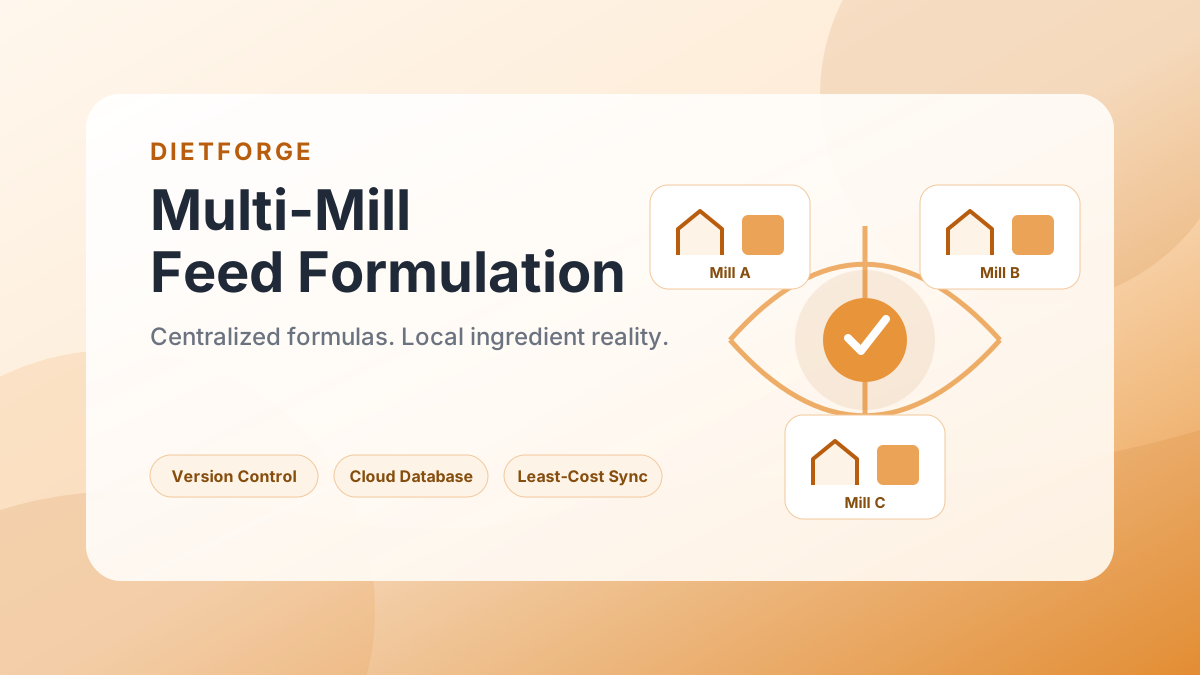
Running feed formulation at a single mill is hard enough. You're managing ingredient variability, nutrient database updates, least-cost optimization runs, regulatory constraints, and the constant tension between margin and performance targets.
Now multiply that across three, five, or ten production sites — each with different ingredient suppliers, different nutritionists, different local market conditions, and different interpretations of what the "approved formula" actually says.
This is the operational reality for mid-to-large feed companies, vertically integrated livestock operations, and multi-site contract manufacturers. And for many of them, formulation consistency across locations is the most stubborn unsolved problem in their technical stack.
This guide breaks down why multi-site formulation is hard, where most organizations go wrong, and how to build a centralized formulation infrastructure that actually scales — without sacrificing the local flexibility that makes each site viable.
1. Why Multi-Site Formulation Is a Different Problem Entirely
Most formulation challenges are technical: wrong nutrient targets, stale ingredient data, overconstrained LP models. Those are solvable with better software and better processes.
Multi-site formulation adds a layer of organizational complexity on top of the technical one. You're not just solving for the right formula — you're solving for the right formula at each site, consistently, in real time, across teams that may have different tools, different habits, and different levels of trust in centralized guidance.
The core tension is this: centralization creates consistency, but ignores local reality. Decentralization accommodates local conditions, but destroys consistency.
Ingredient availability isn't the same in Georgia as it is in Iowa. DDGS prices vary by proximity to ethanol plants. Local soybean meal suppliers have different protein and moisture profiles than what the central database assumes. Regional regulations on certain feed additives or maximum inclusion rates can differ.
A formula that's perfectly optimized at the central office may be infeasible, suboptimal, or simply wrong at Site B — not because your nutritionist got lazy, but because Site B operates in a different ingredient reality.
This is the tension multi-site formulation has to resolve: how do you maintain nutritional standards and brand integrity across all locations while giving each site the flexibility to work with the ingredients actually available to it?
2. Why Ingredient Variability Across Locations Breaks Centralized Formulas
Ingredient variability is the first thing that breaks centralized formulation. It's not a theoretical risk — it's a daily operational fact.
The "Same Ingredient" Is Never Quite the Same
Corn sourced from a Midwest elevator in August has different moisture, starch, and energy values than corn from the same elevator in March. Soybean meal CP and lysine content varies by crush facility, variety, and season. These aren't edge cases — they're routine variation that your formulas have to absorb.
When Site A and Site B are buying from different suppliers, using centralized nutrient values for shared ingredients creates formulations that look identical on paper but perform differently in practice.
Inclusion Rate Differences Cascade Across Nutrients
If Site B can't source canola meal and has to substitute sunflower meal, the amino acid profile shifts. Methionine drops. The lysine-to-methionine ratio changes. To hit the same performance target, the LP solution at Site B needs to be different — not just the ingredient swap, but the rebalancing of everything downstream.
When this happens informally — a nutritionist making a judgment call, emailing a revised Excel sheet, someone at the mill manually adjusting inclusion rates without updating the formula — the system starts to fracture. You lose visibility into what's actually being produced at each site.
Price Variation Means Optimal ≠ Consistent
Least-cost formulation by definition produces different ingredient mixes as prices change. If Site A and Site B are seeing different corn prices — even by $5/ton — their least-cost solutions will diverge. That's fine if you expect divergence and have a system to manage it. It's dangerous if you've issued a "standard formula" that assumes both sites are using the same ingredient mix.
3. Common Mistakes: How Multi-Site Operations Break Down in Practice
Most multi-site feed operations don't fail because of bad nutritionists or bad software. They fail because of coordination failures that accumulate slowly over time.
Siloed Nutritionists Working in Parallel
When each site has its own nutritionist and its own formulation files, you end up with drift — intentional or not. Site A's nutritionist updates the phosphorus minimum because they've seen leg weakness issues. Site B's nutritionist doesn't get the memo. Three months later, a quality audit reveals that Site B's grower diet has been running 0.05% below phosphorus spec.
The siloed model creates a false sense of independence. Each nutritionist thinks they're running a tight operation. But at the company level, you have no real consistency.
Outdated Formula Copies in the Field
This is the version control problem. A formula gets updated at headquarters, exported as a PDF or Excel file, and emailed to the three mill managers. Two of them update their systems. One doesn't — they're in the middle of a production run, it's a Tuesday, and they'll get to it next week.
Next week turns into next month. By then there's a new formula version. The gap widens.
Without a system that enforces formula version control — where mills can only produce from the current approved version and any deviations require documented sign-off — this drift is inevitable.
Manual Syncing Between Systems
Many multi-site operations cobble together workflows across disconnected tools: a formulation tool at the central office, a spreadsheet shared via email for each site, a separate ERP system at the mill that may or may not reflect the approved formula.
Every manual handoff between these systems is an opportunity for error. Ingredient codes don't match. Units differ (kg vs. lb, dry matter vs. as-fed). Someone changes a number in the local spreadsheet and forgets to note why. Six months later, no one knows what the "approved" version actually is.
Treating All Sites as Identical
The opposite error from too much decentralization is too much centralization: issuing identical formulas to all sites without accounting for local ingredient availability, regional nutrient variation, or site-specific performance data.
This creates a different kind of failure — not inconsistency, but systematic suboptimality. Every site is running the "standard formula," but the standard formula was optimized for one site's ingredient reality and is quietly underperforming everywhere else.
4. How to Build a Centralized Formulation System That Works Across Sites
The goal isn't to pick between centralization and decentralization. It's to build a system where nutritional standards are centralized and consistently enforced, while ingredient selection and LP optimization are localized to each site's real conditions.
Here's what that architecture looks like in practice.
Define What's Centralized and What's Local
Start by separating formulation decisions into two categories:
- Nutrient specifications (minimums, maximums, target ranges) for each product category and life stage
- Approved ingredient list and approved suppliers
- Nutrient database — the nutrient values for each ingredient, updated centrally
- Constraint sets — regulatory limits, additive inclusion restrictions, label claim requirements
- Approval workflow for formula deviations
- Local ingredient pricing (updated from their actual purchase orders)
- Ingredient availability (which approved ingredients are actually in stock)
- Production scheduling and batch quantities
- Site-specific performance adjustments within approved parameters
This separation is the foundation. Once it's explicit, the rest of the system is about enforcing it without creating friction.
Build Centralized Nutrient Databases — Not Shared Spreadsheets
The most common technical failure point in multi-site formulation is the nutrient database. When each site has its own copy of ingredient nutrient values, drift is guaranteed — someone updates corn energy on one site, someone else updates soybean lysine on another, and within six months you have five sites running five different databases that no one can reconcile.
The fix is a single source of truth for ingredient nutrition data that all sites read from and no site can modify without central approval. This is a database architecture decision, not a procedural one. Procedures get ignored. Database permissions don't.
When ingredient nutrient data changes — a new lab analysis on your corn supply, an updated CVB table, a supplier change — you update it once, and all sites see the update in their next formulation run.
Implement Formula Versioning with Approval Gates
Every formula should have a version number, an approval status (draft / under review / approved / archived), and an audit trail of who changed what and when.
Mills should only be able to produce from formulas in "approved" status. Any deviation — switching an ingredient, adjusting an inclusion rate — should trigger a review workflow that routes to the central nutritionist or technical manager before the change takes effect.
This isn't bureaucracy for its own sake. It's the mechanism that turns "we have a centralized formula" from a claim into a verifiable fact.
Use LP Optimization Locally, Against Central Constraints
Each site should run least-cost LP optimization against their local ingredient prices and availability — but within the constraint sets defined centrally. The central team defines the floor and ceiling; the local optimizer finds the cheapest path through that space given what's actually available at that site.
This approach gives you consistency where it matters (nutritional outcomes, compliance, brand standards) and flexibility where it's needed (ingredient sourcing, cost optimization, local supplier relationships).
5. The Role of Cloud-Based Software in Multi-Location Management
The architecture described above requires real-time data sharing, centralized database management, version-controlled formulas, and multi-user access with role-based permissions. That's not something you can build with Excel files and email.
It's a software problem — and specifically, it's a cloud software problem.
Why Desktop Formulation Software Hits a Wall
Legacy desktop formulation tools — even the sophisticated ones — were designed for single-user, single-site workflows. One nutritionist, one formulation, one mill. They run locally, store data locally, and have no native mechanism for sharing formulas, syncing ingredient databases, or enforcing permissions across a multi-site team.
When companies try to use desktop software at scale across multiple locations, they end up building workarounds: shared network drives, emailed backups, manual syncing protocols. These workarounds work until they don't — and when they fail, they fail silently.
What Cloud-Native Formulation Enables
A cloud-native formulation platform solves the coordination problem natively because the architecture is built for it:
Single shared database. All sites see the same ingredient nutrition data, updated in real time by the central team. No copies, no versioning drift, no reconciliation.
Role-based access. Central nutritionists can update constraint sets and approve formulas. Site nutritionists can update local pricing and run optimization. Mill managers can view approved formulas but can't modify them. Each role has exactly the access it needs.
Formula versioning. Every change is logged, timestamped, and attributed. Previous versions are preserved. You can always answer "what formula was Site B running on February 14th and what was different from the current version?"
Synchronized pricing. Sites update their local ingredient prices from purchase orders or market feeds. The LP optimizer uses current, accurate prices — not prices from last month's spreadsheet.
Real-time visibility. The central technical team can see what each site is running, flag deviations, compare formulations across sites, and identify consistency gaps before they compound.
6. How DietForge Approaches Multi-Site Formulation
DietForge was built as a cloud-native formulation platform — not a desktop tool retrofitted for the web. That distinction matters for multi-location operations.
The platform maintains a centralized ingredient database that all users in an organization share. When a nutritionist at the central office updates a corn energy value or adds a new approved supplier's soybean meal to the library, that change propagates immediately to every site formulating on the platform — no email, no manual sync, no version mismatch.
Constraint sets can be defined at the organization level and locked for site-level users. A site nutritionist can adjust local ingredient prices and run least-cost optimization, but the nutritional minimums and maximums, approved ingredient list, and regulatory constraints are enforced automatically by the system — not by asking someone to remember to check a document.
For multi-site operations specifically, DietForge gives the central nutrition team a consolidated view of formulations across sites: what each location is running, how current formulations compare to each other, and where divergence has occurred. That kind of visibility is effectively impossible with siloed desktop tools.
The LP solver runs server-side, which means site nutritionists don't need high-spec workstations or locally installed software — they need a browser. For operations with mills in rural areas, limited IT infrastructure, or high staff turnover, that's a meaningful operational advantage.
If you're managing formulation across multiple sites today with a mix of desktop software, shared spreadsheets, and manual coordination, the gap between your current state and what a cloud-native platform enables is likely larger than you expect.
7. Building Toward Multi-Site Formulation Maturity
The transition to a centralized, cloud-based formulation system doesn't have to happen overnight. For most organizations, it's a staged process:
Stage 1: Centralize the database. Start by migrating ingredient nutrient data to a single source of truth. Even if sites are still running separate formulations, at least they're drawing from the same ingredient library. This alone eliminates a major category of consistency failures.
Stage 2: Standardize constraint sets. Define nutritional specifications centrally and document them formally. Start enforcing them in your current tools before migrating to new software. This builds the organizational discipline that software will later enforce technically.
Stage 3: Implement formula versioning. Introduce version control — even manually at first. Number every formula. Log every change. Archive old versions. This creates the audit trail and change management culture you'll need when you move to a formal system.
Stage 4: Move to cloud-native tooling. With the data and processes in place, the technology migration becomes straightforward. You're not changing how you work — you're moving to a system that enforces and automates what you're already doing.
Stage 5: Give sites local optimization within central guardrails. Once the system is in place, extend least-cost LP optimization to each site with local pricing, against centrally-defined constraints. This is the target state: consistent nutritional outcomes, localized cost optimization, complete visibility.
8. What Good Looks Like
A well-run multi-site formulation operation should be able to answer these questions without calling anyone or opening a spreadsheet:
- What formula is Site C currently running for its layer finisher?
- When was it last updated and why?
- How does it compare to what Site A is running for the same product?
- What did Site B pay per ton for corn last week, and how did that change their LP solution?
- Which sites deviated from the approved formula in the last 30 days, and what was the deviation?
If those questions take hours to answer — or can't be answered at all — your formulation management infrastructure has a gap that compounds every month.
The tools exist to close it. The architecture is well understood. What it takes is the decision to treat multi-site formulation management as the operational discipline it is — not an afterthought to the chemistry and nutrition work, but a core capability in its own right.
Ready to bring your multi-site formulation under a single, centralized system? Explore how DietForge handles multi-location formulation management →