As-Fed vs Dry Matter: Feed and Nutrient Conversion Guide
By DietForge Team 5 min read
Topics: Ingredient Management, Practical Calculations
Convert feed nutrients, ingredient inclusions, batch weights, and prices between as-fed and dry-matter bases using transparent worked examples.
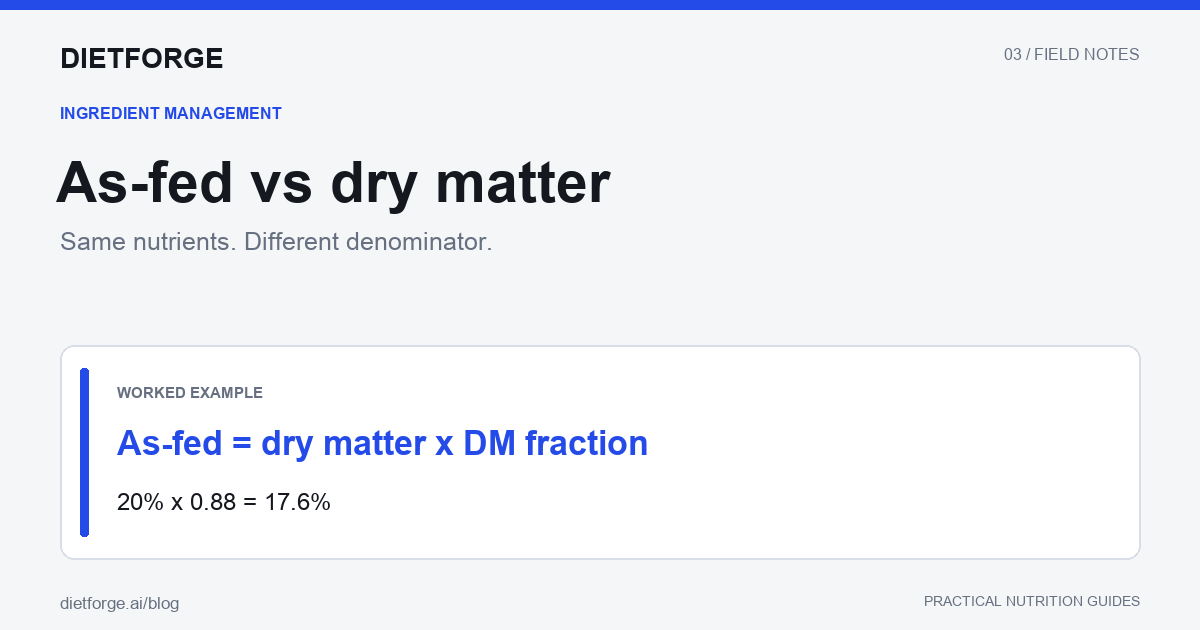
As-fed values include the water in a feed; dry-matter values exclude it. To convert a nutrient concentration from dry matter to as-fed, multiply by the feed’s dry-matter fraction. To convert in the other direction, divide by that fraction.
This distinction affects nutrient specifications, ingredient inclusion, purchase comparisons, and the actual kilograms loaded into a mixer. A moisture mistake can look like a formulation problem even when the optimizer is doing exactly what the data instructs.
Start with the dry-matter fraction
A feed containing 12% moisture contains 88% dry matter. In equations, use 0.88, not 88. The feed’s water fraction plus its dry-matter fraction equals 1.
Penn State Extension’s hay-analysis guide explains why laboratory reports present both as-fed and dry-matter columns. Removing water from the comparison helps distinguish actual nutrient concentration from dilution by moisture.
| Conversion | Equation |
|---|---|
| Dry-matter fraction | 1 − moisture fraction |
| Nutrient, as-fed | Nutrient, dry matter × DM fraction |
| Nutrient, dry matter | Nutrient, as-fed ÷ DM fraction |
| Dry-matter mass | As-fed mass × DM fraction |
| As-fed mass | Dry-matter mass ÷ DM fraction |
Convert a nutrient concentration
Suppose a hypothetical ingredient contains 20% crude protein on a dry-matter basis and 88% dry matter. Its as-fed protein concentration is 20% × 0.88 = 17.6%. One hundred kilograms of the delivered material therefore contains 88 kg dry matter and 17.6 kg crude protein.
Reverse the calculation to check it: 17.6%/0.88 = 20%. The protein mass does not change during this mathematical conversion; the denominator changes. This is not a prediction of what happens to the ingredient during physical drying or processing.
For energy expressed per kg, use the same basis logic. A hypothetical 3,000 kcal/kg DM becomes 2,640 kcal/kg as-fed at 88% DM. Keep the energy system, such as ME or NE, unchanged: converting moisture basis does not convert one energy system into another.
Convert a complete mixture, not just each percentage
Consider 1,000 kg of a hypothetical blend containing 400 kg of wet ingredient A at 35% DM and 600 kg of dry ingredient B at 90% DM.
| Ingredient | As-fed mass | DM mass | Share of mixture DM |
|---|---|---|---|
| A | 400 kg | 140 kg | 20.59% |
| B | 600 kg | 540 kg | 79.41% |
| Total | 1,000 kg | 680 kg | 100% |
The blend is 68% DM. A represents 40% of the as-fed mass but only 140/680 = 20.59% of its dry matter. Multiplying an as-fed inclusion percentage by ingredient DM is only the numerator; divide by the complete mixture’s DM fraction to obtain the share of mixture dry matter.
To work backwards from a DM recipe, divide each ingredient’s required DM mass by its own DM fraction. Then sum the as-fed masses and calculate their proportions. Do not assume the total as-fed batch will equal the original DM batch.
Compare prices on a common basis
Price per tonne DM equals price per as-fed tonne divided by DM fraction. Ingredient A at $80 per as-fed tonne and 35% DM costs $228.57 per tonne DM. Ingredient B at $200 per as-fed tonne and 90% DM costs $222.22 per tonne DM.
The apparently cheaper wet material is slightly more expensive per tonne of dry matter in this example. That still does not identify the better purchase. Nutrient value, freight, shrink, storage, handling, intake, and ingredient limits can change the decision. See our ingredient substitution guide for the broader comparison.
When moisture changes, update the batch instructions
If a ration calls for 100 kg DM from a material, 40% DM requires 250 kg as-fed. At 35% DM it requires 285.71 kg. Continuing to load 250 kg supplies only 87.5 kg DM. Nutrient delivery changes even though the loader display shows the same mass.
Use representative sampling and the approved moisture update process. Keep the lab date, material lot, and basis visible. Penn State’s batch-mixing spreadsheet manual provides background on linking dry-matter ration quantities with as-fed mixing amounts.
Key takeaways
- Use dry matter as a fraction in equations.
- Convert every ingredient and target to a compatible basis before formulating.
- A blend’s DM percentage is a mass-weighted result.
- Moisture-adjusted price is a comparison tool, not a complete valuation.
Frequently asked questions
Does 20% protein on a DM basis mean 20 kg protein in 100 kg delivered feed?
Only if the feed is completely dry. At 88% DM, it means 17.6 kg protein in 100 kg as-fed.
Should I average ingredient DM percentages?
Weight them by as-fed mass. A simple average works only when the ingredient masses are equal.
Can a basis mismatch cause an infeasible formulation?
Yes. It can make the target incompatible with the entered ingredient values. Check units and moisture basis early in an infeasibility investigation.
Keep the ingredient record auditable
Store the source, analysis date, moisture, and nutrient basis alongside your values. Start free with DietForge to organize ingredient data and formulations in a shared workflow.