Pearson Square for Feed Formulation: Worked Example and Limits
By DietForge Team 5 min read
Topics: Feed Formulation, Practical Calculations
Calculate a two-ingredient blend, account for fixed inclusions, and learn when the Pearson square needs to give way to a complete formulation model.
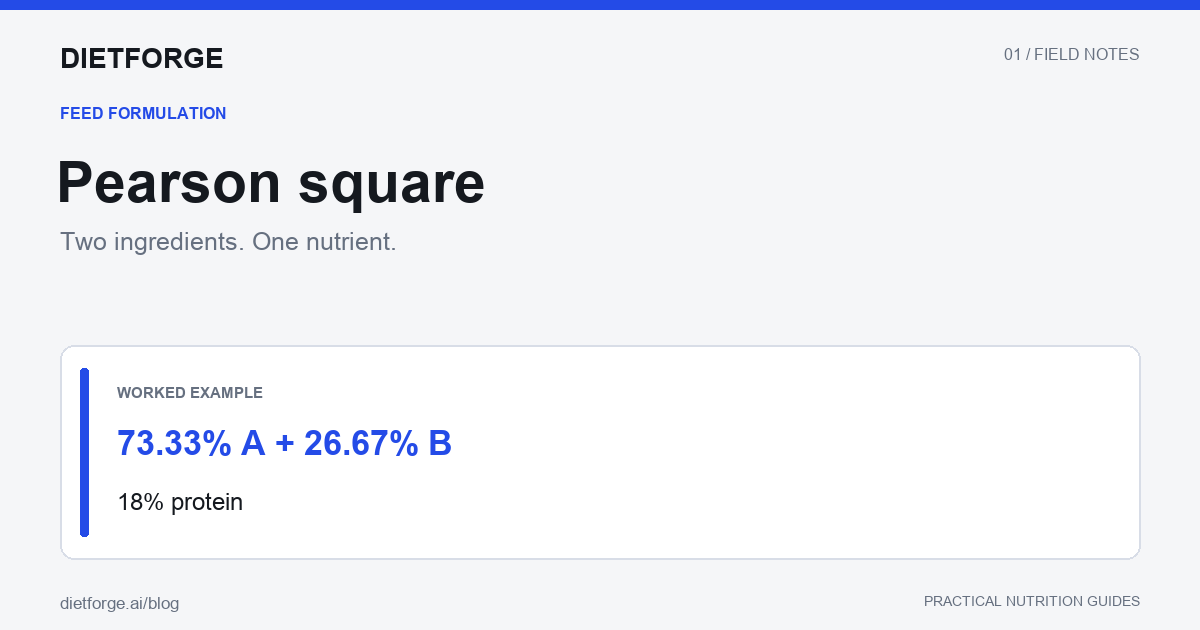
The Pearson square calculates the proportions of two ingredients needed to reach one nutrient concentration. It is useful for checking blend arithmetic. It does not establish that a feed meets an animal’s complete requirements, and it does not find the cheapest solution among many ingredients.
Here is a worked example, followed by the checks that keep a correct calculation from becoming an incorrect feeding decision. All ingredient values below are hypothetical teaching inputs, not a recommended ration.
What the Pearson square can solve
Suppose ingredient A contains 10% crude protein and ingredient B contains 40%, both on an as-fed basis. You want a two-ingredient blend containing 18% crude protein. The target is between the two ingredient values, so a nonnegative blend is possible. The FAO chapter on fish feed formulation explains the square method as an introductory blending tool. The arithmetic applies across feed types; the nutritional specification does not.
The two essential conditions are a shared nutrient basis and a target between the ingredient concentrations. Mixing a dry-matter protein value with an as-fed value produces a meaningless answer even when the square looks tidy.
A step-by-step 18% protein example
- Write the lower concentration, 10%, and the higher concentration, 40%.
- Place the target, 18%, between them.
- Subtract diagonally using positive differences: 40 − 18 = 22 parts of ingredient A; 18 − 10 = 8 parts of ingredient B.
- Add the parts: 22 + 8 = 30.
- Convert to proportions: A = 22/30 = 73.333%; B = 8/30 = 26.667%.
| Hypothetical input | Protein, as-fed | Blend inclusion | Mass in 1,000 kg |
|---|---|---|---|
| Ingredient A | 10% | 73.333% | 733.33 kg |
| Ingredient B | 40% | 26.667% | 266.67 kg |
Check the result independently: 0.733333 × 10% + 0.266667 × 40% = 18%. Alternatively, 733.33 × 0.10 + 266.67 × 0.40 = approximately 180 kg protein in 1,000 kg feed. Keep unrounded values for the calculation and round only the displayed result.
Account for fixed ingredients before using the square
A frequent mistake is to solve the two-ingredient mix at 18% and then add a premix on top. That changes both the batch total and its nutrient concentration. A fixed ingredient must occupy part of the original 100%, with its nutrient contribution included.
For a teaching example, reserve 2% of the complete blend for a fixed component contributing zero crude protein. This is a mathematical assumption, not a premix inclusion recommendation. The remaining 98% must contain 18/0.98 = 18.3673% protein. Apply the square to that adjusted target, then multiply the resulting proportions by 98%.
The complete formula becomes 70.6667% A, 27.3333% B, and 2% fixed component. Check: 70.6667 × 0.10 + 27.3333 × 0.40 = 18 percentage points of protein. If the fixed component contributes protein, subtract that contribution before dividing by the remaining fraction.
Recognize a target the ingredients cannot reach
A 45% protein target cannot be reached using only 10% and 40% protein ingredients. Taking absolute diagonal differences without checking the target range can conceal this impossibility. Likewise, a valid square may violate an ingredient’s practical maximum. The 26.667% inclusion calculated above is unusable if B has an approved maximum of 20%.
Preblending ingredients into two groups can extend the arithmetic, but each group’s internal proportions remain fixed. The square does not choose those proportions, evaluate alternative ingredient prices, or enforce additional restrictions.
Move from blend arithmetic to complete formulation
A production formulation also needs the appropriate energy system, amino acids or protein fractions, minerals, vitamins, ingredient limits, manufacturing constraints, and species-specific considerations. Two blends with identical crude protein can differ substantially in these other properties.
Use the square as a quick independent check. Use a constrained formulation model when multiple requirements or competing ingredients matter. Our Excel Solver walkthrough shows how the problem changes when additional constraints are introduced. First confirm that every coefficient shares the correct as-fed or dry-matter basis.
Key takeaways
- The square solves one concentration using two ingredients or two fixed blends.
- The target must lie between the ingredient values on the same basis.
- Reserve fixed inclusions before solving the remaining blend.
- A balanced protein percentage is not proof of a complete, suitable feed.
Frequently asked questions
Can the Pearson square find the least-cost ration?
Not across a changing set of ingredients and constraints. It determines the proportions for the two inputs you selected. A least-cost model compares feasible combinations while enforcing the full specification.
Can I use dry-matter nutrient values?
Yes, if both ingredients and the target use that basis. The resulting proportions describe dry matter; convert them to as-fed quantities before batching.
What if one ingredient already matches the target?
The arithmetic assigns the entire variable blend to that ingredient. It still does not establish nutritional completeness or satisfy any other inclusion restriction.
Put the calculation to work
For a broader introduction, read our feed formulation guide. You can also start free with DietForge and build a formulation using your own ingredient data and professionally selected specifications.