Phytase Matrix Values: Credit Nutrients Without Double Counting
By DietForge Team 5 min read
Topics: Feed Additives, Nutrient Specifications
Check phytase activity and inclusion math, trace nutrient credits, and avoid double counting phosphorus benefits in feed formulation.
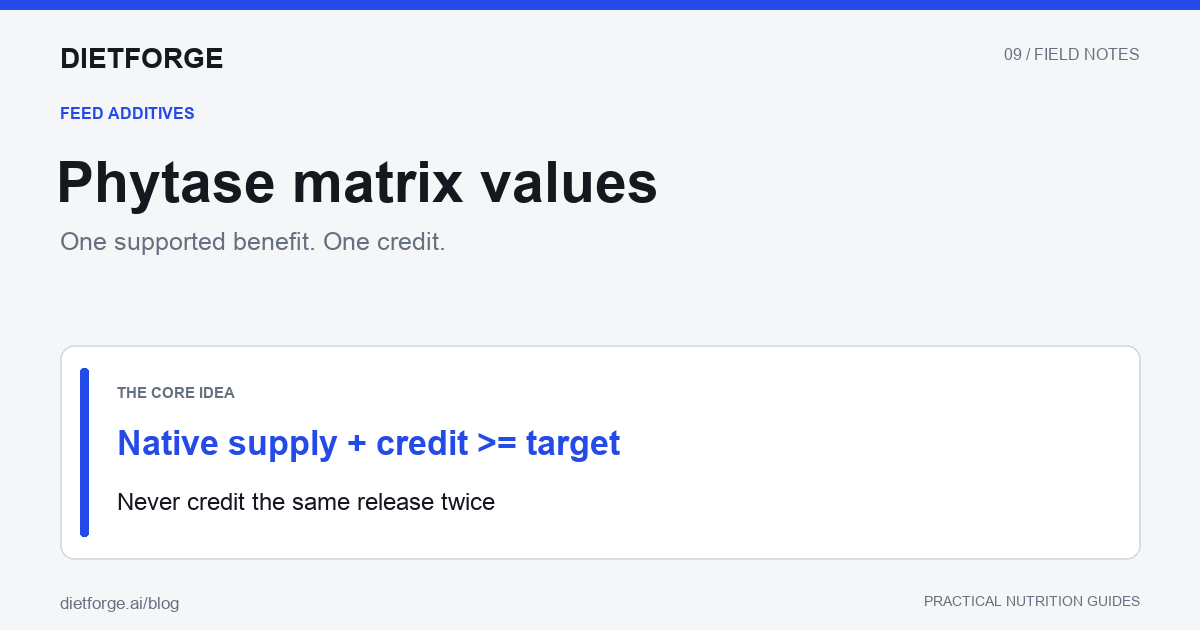
A phytase matrix assigns nutrient credits to a defined enzyme dose under specified conditions. Those credits must be represented once in the formulation. Adding them to ingredient values and also reducing the requirements by the same amount counts the expected benefit twice.
The practical job is to connect the correct product, activity, dose, nutrient basis, and supporting evidence. “Phytase included” is not enough information to establish a valid phosphorus or calcium calculation.
Separate the product from the nutrient credit
Phytase is an enzyme used to release nutrients associated with phytate. The product’s inclusion is a mass, while its activity is expressed in enzyme units. A nutrient matrix is another layer: the credit assigned to that activity level for a particular application.
The review by Dersjant-Li and colleagues describes how enzyme properties, diet composition, processing, and animal factors influence phytase action. That is why a matrix should not be copied blindly across products, doses, or species.
Check the dose calculation before the nutrient calculation
Use a hypothetical product containing 10,000 FTU/g. A teaching target of 500 FTU/kg feed would require:
500 FTU/kg ÷ 10,000 FTU/g = 0.05 g product/kg feed.
That equals 50 g product per metric tonne, or 0.005% inclusion by mass. It is not 0.05%: that would deliver ten times as much product. The dose in this example is for arithmetic only and is not a recommendation for a particular product or animal.
Use the activity on the actual product label and the applicable formulation guidance. Check whether a quoted activity is for the product as supplied or measured in complete feed. Processing and storage can affect recovered activity; any allowance should follow the product’s evidence and quality program rather than an invented multiplier.
Choose one transparent crediting method
There are different ways to represent enzyme benefits in a formulation system. Two common conceptual approaches are:
- Supply-side accounting: leave the requirement unchanged and add an explicit, dose-linked matrix contribution to the calculated nutrient supply.
- Requirement-side accounting: use the uncredited ingredient supply and subtract the approved matrix credit from the corresponding requirement.
These are alternative representations of an approved credit, not two benefits to combine. With nonlinear dose responses or multiple enzymes, implementation requires particular care; a simple additive representation may not describe the supported response.
A small example exposes double counting
Assume, only to demonstrate bookkeeping, a digestible phosphorus target of 0.35% and an approved matrix credit of 0.10 percentage points at the selected dose. Also assume the values share the same digestibility and moisture basis.
| Representation | Constraint |
|---|---|
| Supply-side | Native supply + 0.10% credit ≥ 0.35% |
| Requirement-side | Native supply ≥ 0.25% |
| Double counted — incorrect | Native supply + 0.10% credit ≥ 0.25% |
The first two methods require at least 0.25% native supply. The third permits only 0.15%, effectively claiming the same release twice. Likewise, editing base ingredient values to include enzyme benefits and then adding a separate enzyme credit can duplicate the adjustment.
Keep phosphorus and calcium systems compatible
Total, available, and standardized total tract digestible phosphorus are different fields. A credit stated in one system cannot simply be pasted into another. Calcium constraints and calcium-to-phosphorus relationships also need a compatible basis and approved interpretation.
The Kansas State formulation guide discusses the interaction of calcium and phosphorus in swine specifications. Do not add speculative calcium, amino acid, or energy credits merely because one phosphorus credit is supported.
Do not extrapolate a dose-response without evidence
Doubling enzyme inclusion does not automatically justify doubling nutrient credits. A matrix can be specific to dose, substrate availability, dietary conditions, and the response measured. Two enzyme products may also overlap in the benefit they claim.
Record the exact product and version of its technical guidance. Keep the original matrix document available to reviewers. Where evidence is insufficient, mark the assumption as unresolved instead of hiding it inside an ingredient’s baseline analysis.
Review before releasing a feed
- Confirm product identity, activity units, and target dose.
- Verify the inclusion calculation and mixing practicality.
- Match matrix nutrients to the formulation’s units and basis.
- Trace every credit to its single location in the model.
- Review mineral relationships and any overlapping additives.
- Retain the supporting matrix, approval, and final calculation.
For related workflow issues, see our additive and premix guide and the infeasibility checklist.
Key takeaways
- Activity, product mass, and nutrient credit are separate quantities.
- Apply an approved credit once, with a visible accounting method.
- Match phosphorus and calcium bases before using a matrix.
- Do not assume proportional dose responses or automatic extra credits.
Frequently asked questions
Is the matrix a guaranteed nutrient analysis?
No. It is an assigned credit supported under specified conditions. Its applicability must be reviewed for the actual product and diet.
Can I use the same matrix for pigs and poultry?
Only if the supporting product guidance and evidence establish that use. Species and production stage are part of the review.
Should I overwrite my base ingredient phosphorus values?
Keep uncredited reference values traceable. Whatever accounting method your system uses, reviewers should be able to distinguish native nutrient supply from enzyme-related adjustments.