Shadow Prices in Feed Formulation: What Binding Constraints Cost
By DietForge Team 5 min read
Topics: Feed Economics, Optimization
Understand nutrient shadow prices, units, binding constraints, and reduced costs. Use a worked example to check when a local estimate needs reoptimization.
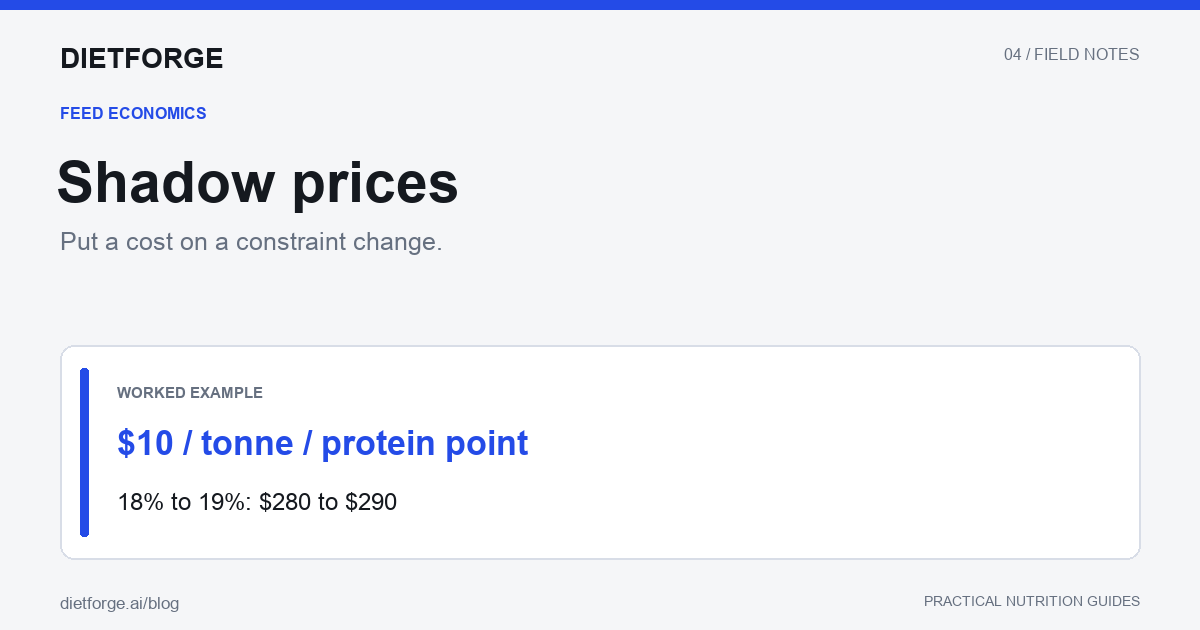
A nutrient constraint’s shadow price estimates how much the optimized feed cost changes when that requirement changes by one unit, locally. It answers a sensitivity question about a particular model, price set, and optimum. It is not a supplier quotation or a permanent value for a nutrient.
The phrase also appears in ingredient purchasing discussions, where it may refer to an ingredient’s opportunity value. Always identify whether a report describes a constraint’s marginal value, an ingredient entry price, or a direct reoptimization scenario.
Start with the constraint and its units
In a linear least-cost model, the objective is to minimize diet cost while meeting requirements and ingredient limits. The Gurobi reference on linear constraint attributes defines the mathematical dual value associated with a constraint. This is a general optimization reference, not a description of DietForge’s solver implementation.
If the objective is dollars per metric tonne and protein is represented as percentage points, the shadow price has units of dollars per tonne per percentage point of protein. If the same requirement is represented in g/kg, the numeric value changes with the unit scale. A number without those labels cannot be interpreted reliably.
Work through a two-ingredient example
Use hypothetical ingredients A and B. A contains 10% protein and costs $200/t; B contains 40% protein and costs $500/t. Ignore every other constraint for this teaching example. To reach 18% protein, the least-cost blend contains 26.6667% B and 73.3333% A.
Its cost is 0.733333 × $200 + 0.266667 × $500 = $280/t. Raising the protein minimum to 19% requires 30% B and gives a cost of $290/t. The local marginal cost is therefore $10/t per one percentage point of protein.
A 0.2-percentage-point increase would predict a $2/t increase while the same relationships remain valid. The change from 18.0% to 18.2% is not a 0.2% relative increase in the requirement; it is 0.2 percentage points. Confusing those two descriptions creates large sensitivity errors.
Why “binding” does not automatically mean expensive
A binding constraint is at its boundary at the solution, within numerical tolerance. A nonbinding minimum has some surplus; a nonbinding maximum has some unused allowance. Tight constraints identify where to investigate, but a binding constraint can still have a zero marginal value, for example because of redundancy or degeneracy.
In the example, a protein minimum below 10% has no cost effect because the cheapest ingredient already supplies 10%. Conversely, adding a maximum on B or another nutrient requirement may change which constraints determine the optimum. Do not infer a unique economic story solely from a highlighted cell.
Use the estimate only within its valid range
A shadow price is local. New ingredients can enter, old ones can leave, and different restrictions can bind after a sufficiently large change. In the teaching model, protein above 40% is impossible. Extrapolating the $10 slope beyond that point would produce a price for a blend that cannot exist.
To evaluate a commercial decision, duplicate the baseline, change the actual proposed requirement, and solve again. Compare the resulting cost, ingredient mix, and full specification. If the software reports an allowable range, respect it; if it does not, verify the scenario directly rather than assuming a range.
Separate reduced cost from constraint sensitivity
An unused ingredient may have a reduced cost indicating how its objective coefficient would need to improve before it becomes competitive, subject to the model’s sign conventions and bounds. That is a different question from the cost of tightening a nutrient requirement.
An ingredient with a promising entry price can still be impractical because of quality variation, minimum purchase quantities, storage limits, or processing effects that the model does not contain. Read our ingredient substitution guide alongside the optimization output.
A useful review sequence
- Save the baseline ingredient matrix, prices, specification, and objective.
- Confirm the solution is feasible before interpreting economics.
- Write down the constraint, direction of change, and units.
- Calculate the local estimate, including the sign convention used by the report.
- Reoptimize the actual proposed change.
- Check manufacturing, purchasing, nutritional, and performance implications before approving it.
For nonlinear or simulation-based scenarios, a finite-difference result may be more appropriate than a linear-program dual. Do not label every change in cost a formal shadow price. State how the estimate was obtained and which assumptions were held constant.
Key takeaways
- Shadow prices describe the current model, not a universal market value.
- Units and sign conventions determine the interpretation.
- Binding constraints can have zero marginal cost.
- Reoptimize meaningful changes rather than extrapolating a local estimate indefinitely.
Frequently asked questions
Can I use shadow prices from an infeasible diet?
Not as ordinary marginal values of a feasible optimum. First investigate why the formulation cannot satisfy its constraints using our troubleshooting guide.
Does a high shadow price justify reducing a requirement?
No. It identifies an economically sensitive restriction. The requirement still needs nutritional justification; removing a necessary requirement can make an inexpensive model result unsuitable.
Will the value change when ingredient prices change?
It can. Recalculate using the current ingredient set, prices, limits, and specification.
Review a real formulation
DietForge Pro includes shadow-pricing analysis. See the plans and use your approved ingredient values to investigate the constraints that drive a diet’s cost.