SID vs Total Amino Acids in Swine Feed Formulation
5 min read
Topics: Swine Nutrition, Nutrient Specifications
Separate total and SID amino acids, calculate digestible contributions, and align swine requirements with ingredient values and the right energy basis.
Total amino acids describe the amount present in an ingredient. Standardized ileal digestible amino acids, or SID amino acids, estimate the portion available after accounting for ileal digestibility and basal endogenous losses. A swine diet specified on a SID basis must be evaluated with compatible SID ingredient values, not total amino acids relabeled as digestible.
This distinction matters when comparing protein sources, using coproducts, adding feed-grade amino acids, or investigating a formulation that meets crude protein but misses a specific amino acid target.
Separate the terms before comparing the numbers
| Term | What it describes | Formulation implication |
|---|---|---|
| Total amino acid | Analyzed or tabulated amount in the ingredient | Does not itself account for digestibility |
| Apparent ileal digestibility, AID | Disappearance measured by the end of the small intestine without the basal-loss correction used for SID | Do not substitute directly for a SID coefficient |
| Standardized ileal digestibility, SID | Ileal digestibility corrected for basal endogenous amino acid losses | Use compatible coefficients and SID requirements |
Kansas State University’s Nutritional Value of Ingredients fact sheet explains the distinction between ileal digestibility systems and the importance of consistent ingredient evaluation. The values belong to a defined ingredient and methodology; they are not a universal discount to apply to every protein source.
Calculate a digestible contribution carefully
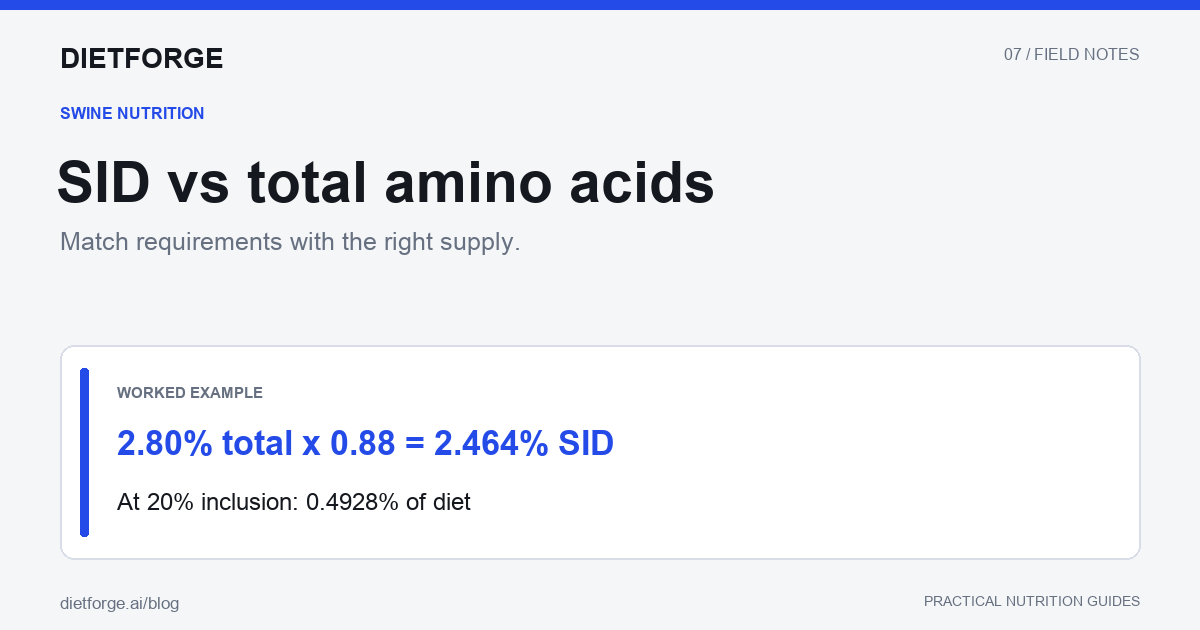
Use a hypothetical ingredient containing 2.80% total lysine as-fed and a SID lysine coefficient of 0.88. Its SID lysine concentration is 2.80% × 0.88 = 2.464%. If it makes up 20% of the diet, its contribution is 0.20 × 2.464% = 0.4928 percentage points of dietary SID lysine.
That is 4.928 g SID lysine/kg of complete feed. Other ingredients must be calculated on the same basis and added to obtain the diet total. These numbers teach the arithmetic and do not represent a specification for a particular age of pig.
If the ingredient database already provides SID lysine concentration, do not multiply by digestibility again. If a coefficient is stored as 88 rather than 0.88, divide by 100 before multiplication. Both errors can produce convincing-looking but incorrect nutrient totals.
Crude protein cannot stand in for an amino acid profile
Crude protein is a broad nitrogen-based measure. Two ingredients with the same crude protein percentage can supply different amounts and proportions of amino acids. A model that constrains only crude protein cannot prove that its lysine, threonine, tryptophan, or other amino acid supply is appropriate.
Feed-grade amino acids can change that relationship further. Their product assay, chemical form, and assigned availability need to be represented correctly. Do not copy one amino acid’s coefficient into every row or use a product’s crude protein equivalent as though it were the concentration of a specific amino acid.
Match the requirements to the animal and energy supply
The appropriate requirement depends on the population, phase, intake, and production objective. Kansas State’s diet formulation guide discusses selecting SID lysine relative to energy and expressing other amino acids relative to lysine. That is a framework for building a specification, not permission to apply a single ratio to every pig.
For an arithmetic example, 1.00% SID lysine equals 10 g/kg. At 2,500 kcal NE/kg, the ratio is 4.0 g SID lysine per Mcal NE. At the same lysine percentage and 2,700 kcal NE/kg, it is about 3.70 g/Mcal. The nutrient concentration did not change, but its relationship to energy did. See our ME and NE guide before comparing energy-linked targets.
Audit the matrix when an ingredient changes
Ingredient identity includes more than a short name. Processing, source, moisture, and analytical method can affect the assigned values. Record total amino acid data, the source of each digestibility coefficient, the applicable animal category, and the resulting digestible concentration.
When replacing a protein source, compare the full amino acid pattern and relevant inclusion limits. A lower price per tonne or lower price per unit of crude protein does not automatically make an ingredient cheaper per unit of the limiting digestible amino acid.
Check whether any imported column is actually AID, SID, total, or a ratio. Verify moisture basis before deciding that two databases disagree. Preserve uncertainty instead of filling missing digestibility values with invented precision.
Key takeaways
- Pair SID requirements with SID ingredient concentrations.
- Do not apply a digestibility coefficient twice.
- Crude protein alone does not define amino acid adequacy.
- Review amino acids alongside energy, intake, phase, and ingredient quality.
Frequently asked questions
Can I convert total lysine to SID with one standard percentage?
No single percentage fits every ingredient and condition. Use an appropriate source for the ingredient and methodology, and document it.
Is SID a dry-matter basis?
No. SID describes the digestibility system. A SID concentration can still be expressed on an as-fed or dry-matter basis, which must be labeled separately.
Why does the formulation meet protein but miss lysine?
The ingredients may supply enough total nitrogen without enough lysine on the specified digestibility basis. Check the individual amino acid contributions rather than inferring them from protein.
Build a specification you can explain
Keep the scientific basis and ingredient sources visible when creating or reviewing a diet. Start free with DietForge to organize that formulation workflow.